Investment Incentive Regime at the Clark Freeport Zone
Law and Investment in Asia: Economic Zones
Ongoing policy reforms in the Philippines aimed at broadening a more diversified mix of foreign investors in significant sectors offers a marked shift in reducing dependence on traditional industries and investment partners. Economic zones utilize policy and regulatory approaches to appeal to wider global audience. The Clark Freeport Zone (CFZ) continues to build on current infrastructure, streamline regulation, and strengthen its fiscal regime.
Historical Perspective
Clark’s history is a story of resurgence. Once a former military installation, and later devastated by the Mt. Pinatubo eruption, Clark has been repurposed into a civilian and economic hub through the policy direction set by the Bases Conversion and Development Act of 1992, with the Bases Conversion and Development Authority (BCDA) guiding its transformation.
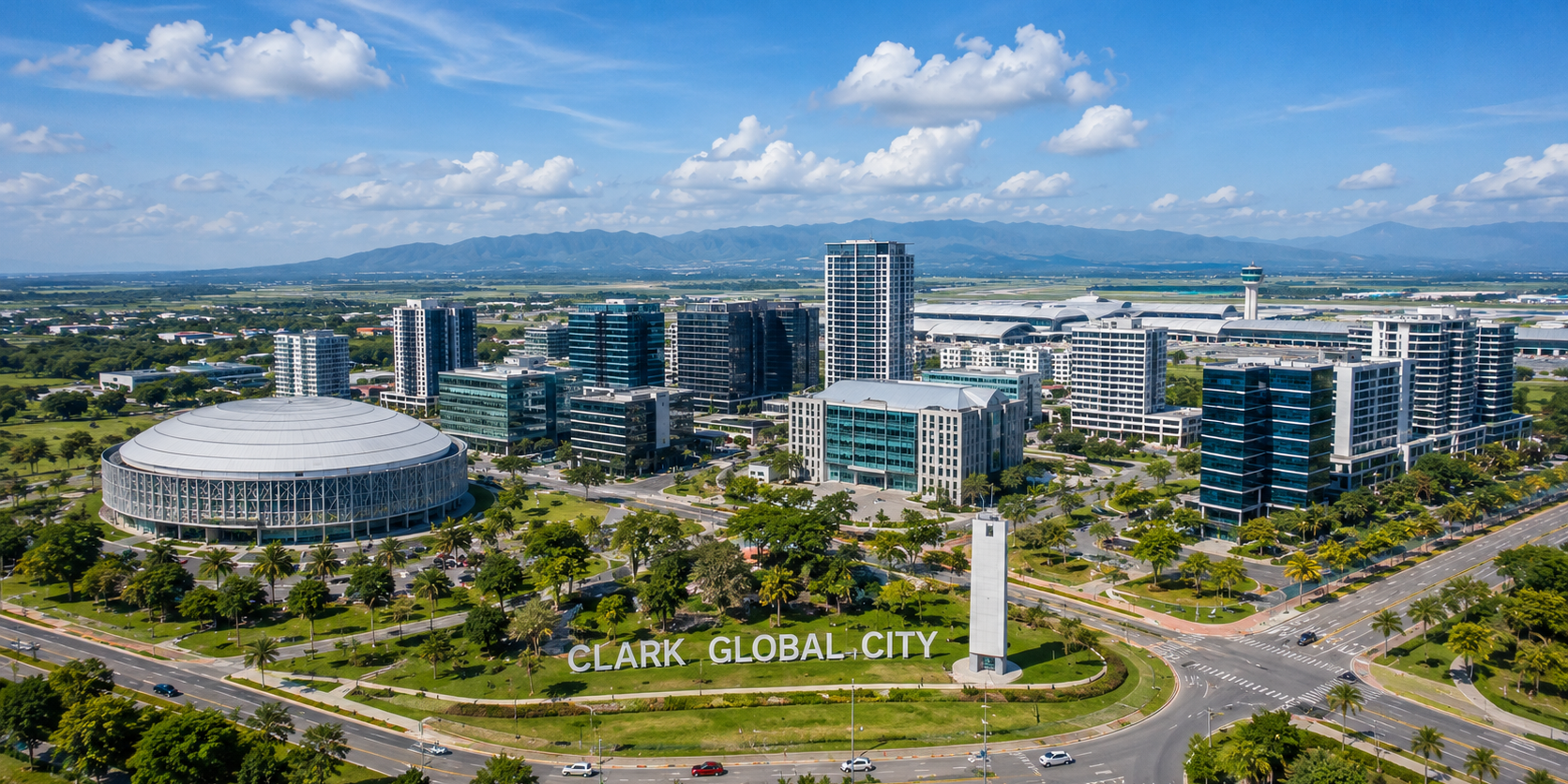
The Clark Freeport Zone became the first major step in this transformation, laying the groundwork for the wider Clark Metropolis that exists today. Under the “One Clark” concept, Clark now brings together the Clark Freeport Zone, Clark Global City, Clark International Airport, and New Clark City into a connected ecosystem for business and urban development.¹
Connectivity and logistics
For businesses looking closely at logistics, Clark offers a growing transport network that brings together air, road, and rail access. Clark International Airport now has a capacity for more than 12 million passengers annually, following the completion of its terminal.² With passenger traffic increasing, the second runway project is also moving forward.³
Clark is located north of metropolitan Manila and supported by major thoroughfares NLEX and SCTEX, giving locators direct access to major transport routes across Central and Northern Luzon.
Within Clark itself, a 60-kilometer Bus Rapid Transit System is being developed to connect key areas which include the airport, the Freeport Zone, and New Clark City.⁴ For regional movement and access, two massive rail projects are actively underway: the North-South Commuter Railway (NSCR) for fast passenger transit to Manila,⁵ and the Subic-Clark-Manila-Batangas (SCMB) Railway.⁶
The latter is intended to give Clark-based businesses a direct freight link to Subic, Manila, and Batangas, helping connect production, port, and markets more efficiently.
For investors, Clark’s value lies not only in where it is, but in what it connects. Its transport links make it easier for businesses to reach workers, suppliers, and customers. This is important for manufacturers, logistics companies, technology firms, and service providers whose operations depend on speed, access, and reliability.
Doing Business in Clark and Menu of Incentives
With these physical advantages in place, the next question for investors is whether the regulatory and tax environments are equally supportive. Infrastructure may bring new businesses to Clark, but predictability and policy consistency allow them to stay, expand, and plan for the long term.
For foreign nationals, predictability begins with market access and ownership. Under the Foreign Investments Act (FIA) and its latter amendment, foreign investors can enjoy up to 100 percent foreign equity in export enterprises and domestic market enterprises whose activities are not restricted by the Foreign Investment Negative List.⁷
To further encourage global capital, the minimum paid-in capital requirement for a micro or small domestic market enterprise has been lowered from USD 200,000 to USD 100,000, subject to certain conditions—most notably, the requirement for direct employment has been drastically reduced, now allowing enterprises that employ a majority of Filipinos, with a minimum of just fifteen (15) direct employees, to qualify for the lowered capital threshold.⁸
Ownership flexibility, however, is only one facet of the investment decision. Once a business is able to enter the market, the next consideration is the applicable tax regine and incentives open to it. This is where the CREATE Act and CREATE MORE Act become important, as they shape the tax incentives available to businesses that are considering locating in Clark.
Eligibility rules
To avail of these incentives, a business enterprise must first ensure that its operations align with the Strategic Investment Priority Plan (SIPP). Formulated by the Board of Investments (BOI), the SIPP serves as the official framework defining which specific industries and projects are eligible for tax incentives.⁹
The SIPP categorizes eligible investments into three tiers, each of which determines the extent of tax incentives a business may receive.¹⁰ These tiers mirror the diverse industries currently expanding in Clark.
Tier 1
Targets activities with high potential for job creation and export activities, those that address market failures caused by the inadequate provision of essential goods and services, those that generate value through innovation, and those that provide essential industrial support, or have developing competitive advantage, among others.
Tier 1 also includes the Information Technology and Business Process Management Sectors like call centers and software developers, mass housing, public infrastructure such as the operation of airports and seaports and pipeline projects.
It also covers modern agriculture and agro-processing (including Halal and Kosher foods, hatcheries, and nurseries), industrial waste and water treatment, logistics operations (like integrated terminal exchanges and motor vehicle inspection centers), energy generation and battery energy storage systems, as well as major tourism enterprises like development of retirement villages, hotels, eco-lodges, and resorts.¹¹
Industries that are strong on green ecosystems, health related and allied medical services, defense, industrial value chain, and businesses related to the promotion of food technology are heavily favored.
Tier 2
Covers activities that produce supplies, parts, components, and intermediate services that are not locally produced but are critical to industrial development, as well as import substituting activities.¹²
These include electric vehicle (EV) assembly, energy-efficient maritime vessels and equipment manufacturing and assembly. This tier also includes integrated waste management, vaccine manufacturing, active pharmaceutical ingredients (API), defense related manufacturing, green metals processing, textiles, crude oil refining and industries related to food security such as food production and processing, production of hybrid seeds, and manufacturing of agricultural machineries.¹³
Tier 3
Envisions research and development industries that drive scientific and health breakthroughs; enterprises that generate and commercialize new intellectual property and patents; advanced technology manufacturing; and activities essential to the structural transformation of the economy.
Examples are robotics, artificial intelligence (AI), additive manufacturing (3D printing), data analytics, research and development hubs, tech startups, science and technology parks, and space-related infrastructures.¹⁴
Once a project qualifies under the SIPP, the business can register with an Investment Promotion Agency like the Clark Development Corporation (CDC) and the Fiscal Incentives Review Board (FIRB) for the availment of the applicable incentives.
Registration brings the enterprise under the incentives framework of CREATE and CREATE MORE, allowing the enterprise to enjoy unprecedented fiscal and non-fiscal incentives.
Highly Competitive Fiscal Perks
The strongest financial draw under the CREATE and CREATE MORE framework is the Income Tax Holiday (ITH). Depending on their location and SIPP industry tier, registered business enterprises are granted absolute exemption from corporate income tax for a period of four (4) to seven (7) years reckoned from the start of commercial operations.¹⁵
This is crucial because during project infancy, the business is most financially exposed. Before a registered enterprise can fully recover its investment, it must spend on facilities, equipment, and other start-up costs. The ITH softens this burden by allowing an enterprise to keep more of its earnings during this period, giving it more room to stabilize operations.
After the initial tax holiday, CREATE MORE ensures long-term fiscal predictability by transitioning enterprises into highly competitive tax regimes. The law allows them to move into incentive regimes that make their tax costs more predictable in the long term.
For qualified export enterprises, one option is the 5% Special Corporate Income Tax (SCIT) based on gross income earned. This 5% percent rate is paid in lieu of all national and local taxes, as well as local fees and charges.¹⁶ This incentive offers a simpler tax structure and may be more appealing to export enterprises with stronger profit margins.
Another option is the Enhanced Deductions Regime (EDR), which is available to both Registered Export Enterprises (REEs) and Domestic Market Enterprises (DMEs). Under CREATE MORE, businesses under the EDR are subject to a reduced 20% corporate income tax rate on taxable income.¹⁷
This is coupled with allowable deductions for expenses such as power, training, direct labor, and participation in trade fairs or exhibitions, among others.¹⁸ CREATE MORE further allows REEs to forego the ITH and immediately elect either the SCIT or EDR from the actual start of commercial operations.¹⁹ Similarly, DMEs may now immediately elect to be covered by the EDR from day one.²⁰
Recent legal developments have given registered enterprises under the EDR a more useful window for applying net operating losses incurred during the ITH period. Instead of counting the five-year carry-over period from the year the loss was incurred, CREATE MORE allows losses incurred during the first three years of operation to be carried over within the next five years immediately after the last year of the ITH period.²¹
In simple terms, this means that losses incurred during the ITH period are not wasted while the enterprise has no corporate income tax to reduce. Instead, those losses may be used after the ITH, when the enterprise becomes subject to income tax and the deduction can produce an actual tax benefit.
The CREATE framework also gives export-oriented enterprises a measure of commercial flexibility. Under CREATE MORE, REEs are allowed to sell a portion of their output to Philippine customers without necessarily losing their export status.²² While local sales remain subject to VAT and proportionate customs duties,²³ this allowance gives REE’s an opportunity to diversify their revenue streams and test the local market.
An added measure of predictability made possible by recent legal developments is the Registered Business Enterprise Local Tax (RBELT). During the ITH and EDR, the RBELT caps the local tax exposure of RBEs to (2%) of its gross income. This amount is paid in lieu of all other local taxes, fees, and charges imposed by the local government units.²⁴
For investors, this provides a clearer ceiling on local taxes and reduces uncertainty from varying local impositions. Enterprises under SCIT, however, are not subject to the RBELT, since the SCIT is paid in lieu of national and local taxes.²⁵
CREATE MORE also expands the coverage of VAT zero-rating on local purchases for REEs and qualified High-Value Domestic Market Enterprises (HVDMEs),²⁶ as well as customs duty exemptions for REEs and all DMEs,²⁷ by replacing the earlier “directly and exclusively” standard with the broader concept of goods and services “directly attributable” to the registered project or activity.²⁸
This is crucial since many support costs, while not part of the production process itself, are still necessary to the registered enterprise’s operations. Under the amended rules, the coverage now extends to goods and services that are incidental to and reasonably necessary for the registered activity, including administrative and support services such as security, human resources, legal, janitorial and accounting services, among others.²⁹
Choosing the CFZ
Clark’s trajectory as the Asia-Pacific’s next major investment hub is difficult to ignore. As of 2025, the Clark Freeport Zone supports 149,138 workers across 1,256 locators and generates US$3.81 billion in exports (excluding Texas Instruments).³⁰
It also makes efficient use of developable land, producing up to Php1.7 million in earnings per hectare, a figure that compares favorably with other Philippine economic zones.³¹ With New Clark City already securing more than Php 143 billion in investments and expected to generate over 103,000 jobs in the coming years,³² Clark offers investors both an established business base and a clear path for future growth.
Ultimately, the decision to invest in Clark is not limited to fiscal incentives. Clark offers investors a location that is being deliberately developed for long-term business growth, mobility, and livability. Unlike heavily congested urban centers, Clark is positioned as a metropolis where commercial, industrial, residential and recreational areas are designed to complement one another.
The continuing development of New Clark City reinforces this direction, with its emphasis on accessibility, open spaces, and integrated communities. With its commitment to preserving 60% of its land for green and open spaces,³³ and with a location that offers greater resilience against natural hazards,³⁴ Clark offers a strategic location for both enterprises and workforce.
Clark’s trajectory is undeniable. Backed by aggressive government support and the massive logistics infrastructure already underway, the region is rapidly transforming into one of the premier logistics and investment hubs in Asia.
When paired with the incentives under CREATE MORE, Clark offers a strong case as one of the country’s most promising investment destinations. For forward-thinking investors, all roads truly lead to Clark—a thriving, world-class metropolis perfectly positioned for long-term, sustainable growth.
Footnotes
1 BCDA, 2022 new clark primer, p. 4; BCDA, clark magazine 2025, p. 8;
2 Clark International Airport, “Clark International Airport Records Remarkable Passenger Growth, Meets 2024 Targets”, @ https://clarkinternationalairport.com/clark-international-airport-records-remarkable-passenger-growth-meets-2024-targets/
3 BCDA, “BCDA Moves Forward with CRK Second Runway Project,” BCDA Official Website, @ https://bcda.gov.ph/news/bcda-moves-forward-crk-second-runway-project
4 BCDA, Clark magazine 2025, p. 7
5 Id., at 31
6 BCDA, “BCDA Continues to Secure ROW for SCMB Railway Project,” BCDA Official Website, @ https://bcda.gov.ph/news/bcda-continues-secure-row-scmb-railway-project
7 RA 7042, Sec. 6,7 and 8; RA 11647, sec 8, amending sec. 8 of RA 7042; Forvis Mazars, “Amendment to Foreign Investments Act,” Doing Business in the Philippines Updates, @ https://www.forvismazars.com/ph/en/insights/our-publications/doing-business-in-the-philippines-updates/amendments-to-foreign-investments-act
8 RA 11647, sec 8, amending sec. 8 of RA 7042.
9 RA 12066, sec 16, amending sec. 292 of NIRC; IRR 12066, Rule 1, Sec. 4(hh)
10 2020 Investments Priorities Plan; 2022 SIPP; BOI, BOI Briefer on RA 11534 for Investors, 28 March 2021, p. 7; BOI MEMORANDUM CIRCULAR NO. 2021 – 001
11 2020 Investments Priorities Plan; RA 11534, Sec. 16, adding Sec. 296(A) to NIRC.
12 BOI, Investor Briefer, 28 March 2021, p. 8
13 BOI MEMORANDUM CIRCULAR NO. 2022 – 007, 2022 SIPP
14 2022 SIPP; BOI, Investor Briefer, p. 9
15 RA 12066, sec 20, amending sec. 296 of NIRC; https://taxsummaries.pwc.com/philippines/corporate/tax-credits-and-incentives; Fiscal Incentives Review Board (FIRB) Secretariat, “What tax incentives can investors unlock under CREATE MORE?” @ https://firb.gov.ph/resources/create-more/
16 RA 12066, sec 17, amending sec. 294 of NIRC
17 Id.
18 Id.; RA 11534, Sec. 16, adding Sec. 294(C)(2) to NIRC.
19 RA 12066, sec 18, amending sec. 295(A)(2) of NIRC.
20 RA 12066, sec 18, amending sec. 295(B)(2) of NIRC.
21 RA 12066, sec 17, amending sec. 294(C)(9) of NIRC; IRR RA 12066, Rule 2, Sec.1 (C)(IX).
22 RA 11534, Sec. 16, adding Sec. 293(E) to NIRC; IRR RA 12066, Rule 1, Sec 4(n).
23 IRR RA 12066, Rule 2, Sec.3.
24 RA 12066, sec 17, amending sec. 294(F) of NIRC; IRR RA 12066, Rule 2, Sec 5.
25 RA 12066, sec 17, amending sec. 294(B) of NIRC.
26 RA 12066, sec 18, amending sec. 295(D)) of NIRC; IRR RA 12066, Rule 2, Sec 3; RA 12066, sec 17, amending sec. 294(E) of NIRC.
27 RA 12066, sec 17, amending sec. 294(D) of NIRC; IRR RA 12066, Rule 2, Sec 2.
28 RA 12066, sec 16, amending sec. 293(D) of NIRC; IRR RA 12066, Rule 2, Sec. 2.
29 IRR RA 12066, Rule 1, Sec 4(k).
30 CDC, 2025 Accomplishment Report, p. 22.
31 Id., p. 15.
32 BCDA, Clark Magazine 2025, p. 28.
33 Id.
34 CNN Philippines: The Philippines is building a green, disaster-resilient city (July 23, 2018) @ https://edition.cnn.com/style/article/new-clark-city-philippines/index.html
DISCLAIMER
This article should neither be taken as legal advice nor be relied on as the basis of any action or decision. The views and opinions expressed here do not reflect the views and opinions of the organization to which the authors belong. Readers should seek the services of a legal professional before making any action or decision on any matter discussed in this article.
For enquires and comments, please email [email protected]